|
|
|
|
Original Article
Assessment of Some Physico-chemical Parameters in Saikheda Dam, Dist. Yavatmal, (M.S.), India
|
Sujata H.
Shende 1*, Maryam Begum Mohammad Abuzar 2 1 Department Botany, Shivramji Moghe Arts, Commerce and Science College, Pandharkawada, Kelapur Dist. Yavetmal, India 2 Research Scholar, Shivramji
Moghe Arts, Commerce and Science College, Pandharkawada,
Kelapur Dist. Yavetmal,
India |
|
|
|
ABSTRACT |
||
|
Saikheda dam is an earth fill on river Khuni near near Mohodha in Ghatanji Taluka of Yavatmal District, nearest city to dam is Pandharkawada. The dam is Earth fill dam. Purpose of dam is for irrigation. Length of dam is 1740 M. (5708.66 feet) and height of dam above lowest foundation is 23.77 (77.98 feet). The current study based on the physico-chemical parameters such as water temperature, pH, dissolved oxygen (DO), nutrient levels nitrate and phosphate serve as critical indicators of water quality in Saikheda dam water body. These factors determine the habitat suitability for aquatic life, phytpplankton diversity amid local stressors like groundwater extraction and fertilizers use common in Maharashtra's agrarian landscapes. Keywords: Saikheda dam, Critical indicators, aquatic life and fertilizers. Keywords: Saikheda Dam, Critical Indicators, Aquatic Life and Fertilizers |
||
INTRODUCTION
Freshwater is
constantly replenished through precipitation in the form of rain and snow, and
it exists in various forms such as lakes, rivers, reservoirs, and subterranean
sources. Due to the growing human population, agricultural expansion,
industrial growth, and urban development, freshwater ecosystems are some of the
most vulnerable to degradation and significant changes caused by habitat
destruction. Examples of freshwater biotopes include temporary pools, streams,
large natural lakes, man-made reservoirs, and river systems. Among these types,
lentic environments host a wide variety of aquatic species and greatly enhance
the productivity of the water. As a result, understanding the structure,
makeup, and production of freshwater communities overall, with a particular
focus on plankton, becomes essential. The importance of the green space in
preserving the biological balance is the key feature of dams and lake water Ganvir et al.
(2024).
Productivity in
freshwater ecosystems, influenced by physical and chemical elements, plays a
crucial role in shaping the existence and population of meiobenthic organisms Moss (2010). Various forms of saprophytic life inhabit
the substrates of standing water environments such as ponds, lakes, and
reservoirs, among others.
Materials and Methods
Water samples were
collected from the Saikheda dam at consistent
intervals during the period from July 2023 - June 2024, specifically in the
early morning from 7:30 am to 10:00 am. from the stations - S1, S2, S3, and S4
by using five-liter containers, taken from a depth of
15-20 centimetres beneath the water surface by positioning the container
upwards. Assessment of some physico-chemical
parameters such as water temperature, pH, dissolved oxygen, phosphate and
nitrate carried out with the standard methods given by APHA (2023).
Results and Discussion
The study of some physico-chemical parameters from Saikheda
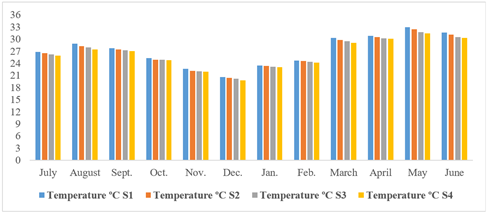
Dam shows the following results such as; the temperature of water fluctuated
between 19.85 and 31.6 (°C) during the initial research phase. The highest
water temperature was recorded at station - S1 in June, while the lowest
occurred at station - S4 in December.
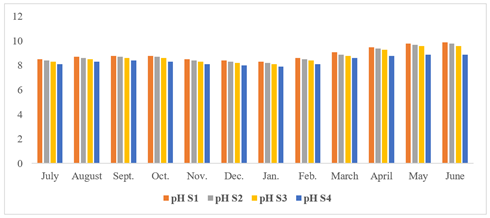
The pH varied from 7.5 to 8.8 throughout the initial investigation. The
peak pH was found at station - S1 in March and May while the lowest pH was
measured at station - S4 in January Figure 1 and Figure 2. The water temperature and pH findings
identical with the findings of Pangul et al.
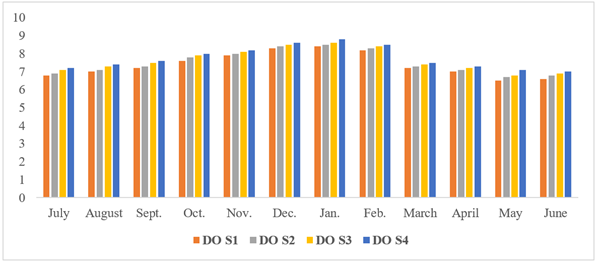
(2024). Dissolved oxygen levels ranged from 6.5 to
8.8 (mg/L) during the preliminary study period. The highest level of DO was
observed at station - S4 in January, whereas the lowest was at station - S1 in
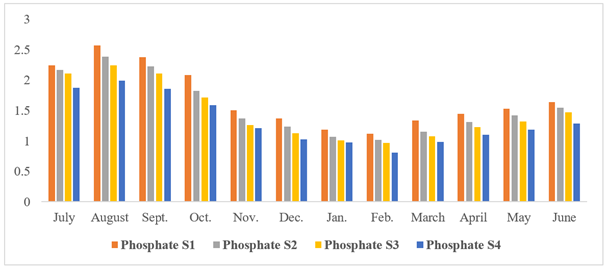
May. The phosphate concentration ranged from 0.81 to 2.57 (mg/L) throughout the
primary investigation timeframe. Ingale
et al. (2015) and Gharpure
et al. (2017) reported analogous relation with current
study. The highest levels of phosphate were detected at station - S1 in August,
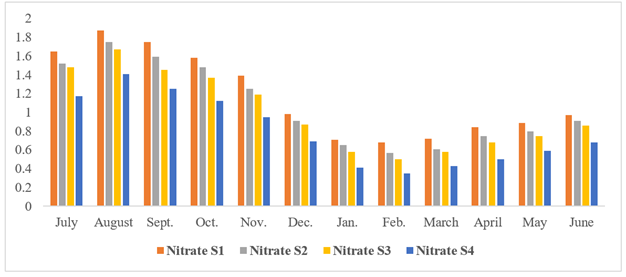
and the lowest levels were recorded at station - S4 in February. Nitrate levels
were reported to vary between 0.35 and 1.87 (mg/L) during the initial phase of
the investigation. The maximum concentration of nitrate occurred at station -
S1 in August, while the minimum was noted at station - S4 in February Figure 3, Figure 4 and Figure 5. Findings of dissolved oxygen, phosphate and
nitrate were parallel with the recent study of Bobdey et al.
(2014), Khiradkar et
al. (2017), Ingale
et al. (2018).
Conclusion
Primary
investigation consistent observation of physico-chemical
factors such as temperature, pH levels, dissolved oxygen, nitrates, and
phosphates in the water of Saikheda dam is crucial
for the preservation of aquatic ecosystems and the overall health of the
environment. Analysis indicates that keeping these factors within ideal ranges
contributes to a diverse phytoplankton community and variety of species in the Saikheda dam.
|
Figure 1 |
|
Figure 1 Showing Monthly Water Temperature Values
of stations S1, S2, S3 and S4 in Saikheda Dam Water
District Yavatmal During July 2023 - June 2024. |
|
Figure 2
|
|
Figure 2 Showing Monthly pH from Values of Stations
S1, S2, S3 and S4 in Saikheda Dam Water District Yavatmal During July 2023 - June 2024. |
|
Figure 3
|
|
Figure 3 Showing Monthly Dissolved Oxygen Values of
Stations S1, S2, S3 and S4 in Saikheda Dam Water
District Yavatmal During July 2023 - June 2024. |
|
Figure 4
|
|
Figure 4 Showing Monthly Phosphate Values of
Stations S1, S2, S3 and S4 in Saikheda Dam Water
District Yavatmal During July 2023 - June 2024. |
|
Figure 5
|
|
Figure 5 Showing Monthly Nitrate Values of Stations
S1, S2, S3 and S4 in Saikheda Dam Water District Yavatmal During July 2023 - June 2024. |
ACKNOWLEDGMENTS
None.
REFERENCES
APHA. (2023). Standard Methods for the Examination of Water and Wastewater
(24th ed.). APHA Press.
Bobdey, A. D.,
Ingale, P. P., and Lonkar, A. N. (2014). Evaluation of Water Quality
in Bhiwapur Lake, Dist.
Nagpur (MS) India on the basis of some physico-chemical parameters.
International Journal of Researches in Biosciences, Agriculturs and Technology,
Special Issue, 478–484.
Ganvir,
P. M., Bansod, D. S., and Ingale, P. P. (2024). Avifauna
Diversity of Two Natural Lakes in District Gadchiroli,
(MS) India. Indian Journal of Applied and Pure Biology,
39(3), 1828–1833.
Gharpure, V. L., Bhatkulkar, M., and Ingale, P. P. (2017). Preliminary study of water quality with respect to some physico-chemical parameters in Vena river. IJRBAT, 5(Special Issue 2), 1161–1164.
Ingale, P. P., Bobdey, A. D., and Gorghate, N. D. (2018). Comprehensive Hydrobiological Status of Bhiwapur Lake of Maharashtra India: An environmental aspect. Journal of the Chinese Advanced Materials Society, 6(4), 655–665. https://doi.org/10.1080/22243682.2018.1537005
Ingale, P. P., Bobdey, A. D., and Lonkar, A. N. (2015). Monthly
Variations in Physico-Chemical Characteristics of Bhiwapur Lake dist. Nagpur (MS)
India. Journal of Innovation in Science, 2(2), 81–87.
Khiradkar, S. S., Kambdi, R. R., Ingale, P. P., and Gorghate, N. D. (2017). Preliminary Study of Some Physico-Chemical Parameters in Labhansarad Dam in
Warora Taluka of Chandrapur District, Maharashtra
State, India. International Journal of Researches in
Biosciences, Agriculturs and Technology,
5(Special Issue 2), 965–968.
Moss, B. (2010). Ecology of Freshwaters: A View for the Twenty-First Century (4th ed.). Wiley-Blackwell.
Pangul, A., Yadav, S. N., and Ingale, P. P. (2024). To Investigate the Emphasis on Ecology Based on Seasonal Variation of Some Physico-Chemical Parameters in Salaimendha Dam Near Hingana Tehsil District Nagpur M.S. India. International Journal of Life Sciences, 12(4), 551–556. https://ijlsci.in/ls/index.php/home/article/view/1498
|
|
 This work is licensed under a: Creative Commons Attribution 4.0 International License
© JISSI 2026. All Rights Reserved.