|
|
|
|
Original Article
A study of seasonal zooplankton proportion from Sunegaon lake taluka Loha dist. Nanded (M.S.), India
|
Susmita S. Khiratkar 1*, Varsha F. Dabhade 2 1 Adarsh Education’s
Society’s ACS College, Hingoli - 431513, India 2 Department of Zoology, Madhavrao Patil
College, Palam Dist. Parbhani - 431720, India |
|
|
|
ABSTRACT |
||
|
The stability of the freshwater ecosystems around the world is being threatened by a number of different factors. Zooplanktons are extremely useful indicators of environmental stresses due to the fact that they are sensitive to disturbances from the outside world. Furthermore, this work provides a valuable resource for the management of the health of aquatic ecosystems and the preservation of aquatic biodiversity. At each of the five locations where samples were collected on an annual basis, seasonal variations were observed exhibiting themselves. Following an examination of the sample, it was discovered that there were zooplankton species present. These species included rotifers, copepods, cladocera, and ostracoda. The analysis of zooplankton is to be performed with the help of Sedgwick Rafter Cell Method in the laboratory. Keywords: Ecosystems, Biodiversity, Zooplankton,
and Sedgwick Rafter Cell Method |
||
INTRODUCTION
The freshwater ecosystems, which include reservoirs, dams,
lakes, ponds, and tanks, are indisputable proof that they are the most
important sources of drinking water and irrigation water Khiradkar et al. (2017). During certain
periods, a greater number of zooplanktons are consumed, and these zooplanktons
function as environmentally beneficial indicators. It is imperative to have a
comprehensive understanding of the abundance, distribution, and community
composition of zooplankton in order to comprehend the operation of aquatic
ecosystems and to enhance their functionality. The zooplankton community is
composed of a variety of zooplankton types, in addition to phytoplankton. These
enable primary producers and the upper tropic levels, including fish, to
communicate directly with one another. The majority of fish depend on
zooplankton as their primary source of nutrition during their larval stages Ingale
et al. (2024). Additionally, certain
fish continue to obtain their sustenance from zooplankton for the duration of
their lives. The assessment of the variety to estimate the zooplankton
proportion (rotifera, copepoda,
cladocera, and ostracoda)
from the freshwater Sunegaon lake can therefore provide insight into the
ecological quality of aquatic environments. For the purpose of providing
support for India's expanding economy and population, it is essential to ensure
the sustainable management of lake water supplies Pangul et al. (2024).
Materials and Methods
An examination of the zooplankton proportion of the water in Sunegaon lake is the subject of this research article. Sunegaon lake in Loha taluka, Nanded district is one of the important water body and as per our knowledge no literature is available on zooplankton study. Sunegaon lake water was chosen for the purpose of conducting research on the zooplankton proportion with five sampling stations (A, B, C, D and E). The sampling of water that was carried out between the months of July 2023 and June 2024 has been completed.
The monsoon, winter and summer seasons were the three main research periods. The process of gathering zooplankton samples at random involved passing 100 lit. of water over a zooplankton net composed of bolting silk. The zooplankton samples were preserved using a suitable glass container and 4% formalin. The sample should be placed in a "Sedgwick rafter counting cell" using the Sedgwick Rafter plankton method Adoni (1985). The sample should be one milliliter in volume. Zooplankton was examined using a binocular magnifying lens and a number of different intensities of magnification. During the process of counting zooplankton in the counting chamber, various standard keys that were proposed by Needham and Needham (1962) and Altaf (2004) were utilized to identify and differentiate specific zooplankton.
Sedgwick Rafter Cell Method
Counting of the
organisms was done by following formula.

n = (a x 1000) x C
I
n = Number of
plankton/litre of water.
a = Average of plankton
in one small chamber.
C = ml. of plankton
concentration.
I = Volume of original
water filtered in litre.
Results and Discussion
For the purpose of
determining the percentage of zooplankton that is present in Sunegaon lake,
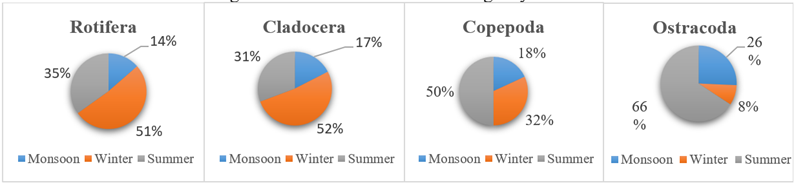
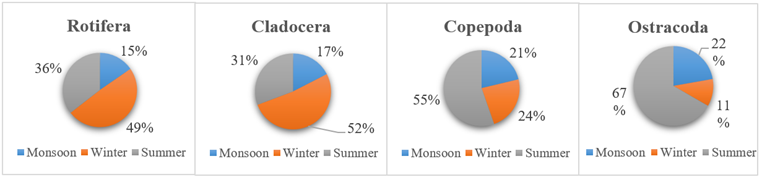
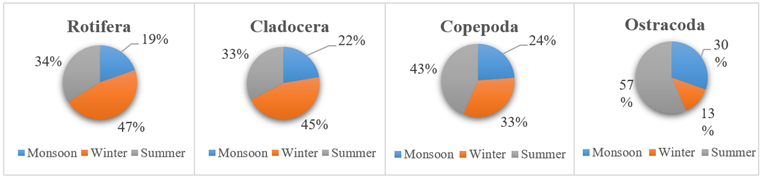
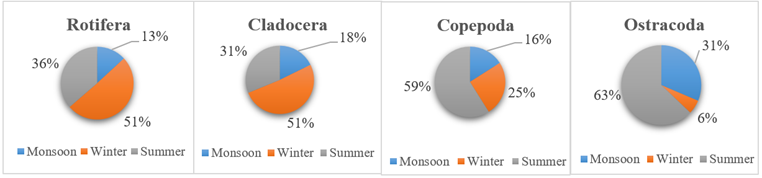
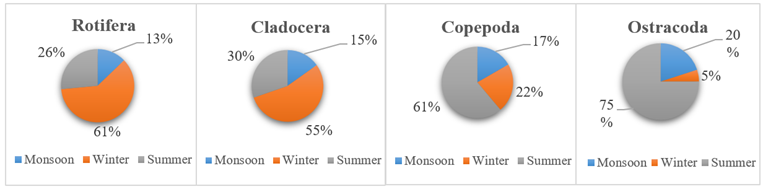
five sampling stations, namely A, B, C, D and E, were chosen Figure 1 to Figure 5. These sampling stations were chosen on
the basis of four different groups, namely rotifera, cladocera, copepoda, and ostracoda. The findings of the current study indicate that
the highest number of zooplankton was observed during the winter and summer
season, while the lowest number was observed during the monsoon season.
Additionally, a moderate proportion of zooplankton was recorded during the
summer season from each of the five sampling stations. In which the station -
C, B, A and D showing maximum proportion of rotifer and cladocera
during winter season and station – C, D, A and B copepoda
and station – C, A, D and B ostracoda showing maximum
proportion respectively, while minimum zooplankton proportion at station - E
during monsoon season with respective group of rotifera,
cladocera, copepoda, and ostracoda. The present results corroborated with findings
of Ingale
et al. (2016), Ingale et al. (2018) and Ingale et al. (2024) from different lake ecosystem.
|
Figure 1
|
|
Figure 1 Pie Diagram Showing Seasonal Variation (%)
of Zooplankton Group from Sunegaon Lake from Station - A during July 2023-
June 2024. |
|
Figure 2
|
|
Figure 2 Pie Diagram
Showing Seasonal Variation (%) of Zooplankton Group from Sunegaon Lake from
Station - B During July 2023- June 2024. |
|
Figure 3
|
|
Figure 3 Pie Diagram
Showing Seasonal Variation (%) of Zooplankton Group from Sunegaon Lake from
Station - C during July 2023- June 2024. |
|
Figure 4
|
|
Figure 4 Pie Diagram
Showing Seasonal Variation (%) of Zooplankton Group from Sunegaon Lake from
Station - D during July 2023- June 2024. |
|
Figure 5
|
|
Figure 5 Pie Diagram Showing Seasonal Variation (%)
of Zooplankton Group from Sunegaon Lake from Station - E during July 2023-
June 2024. |
Conclusion
The findings of the study indicate that this course of action is of great significance from an ecological and environmental point of view respectively. According to the findings of this research, the number of rotifers, cladocerans was at its highest during the winter and copepods and ostracoda during summer season, while went down to its lowest during the monsoon season. All through the year, the zooplankton make their niche there. Fish can benefit greatly from consuming them as a source of food. Consequently, there ought to be a great deal of fish in Sunegaon Lake.
ACKNOWLEDGMENTS
Mahajyoti supported this
research with a grant. This research could not have been done without the
support given by Mahajyoti. I would also like to acknowledge Mahajyoti due to their financial assistance and resources
they gave me to help in the process of research. Additionally, I thanks to
Prof. Dr. Vilas Aghav – Principal, Prof. Dr. B.S. Salve - Head, Dept. of
Zoology, Prof. Dr. P. P. Joshi – Faculty Dept. of Zoology, and Dr. S. S.
Nagarkar - Co-ordinator, Research center of Adarsha
Education society, Arts, commerce and Science College, Hingoli,
for providing research facilities in place of research.
REFERENCES
Adoni, A. D. (1985). Workbook
on Limnology. Pratibha Publishers.
Altaff, K. (2004). A Manual of Zooplankton (p. 145). University Grants Commission.
Ingale, P. P., Bobdey, A. D., and Gorghate, N. D. (2018). Comprehensive Hydrobiological Status of Bhiwapur Lake of Maharashtra, India: An Environmental Aspect. Journal of the Chinese Advanced Materials Society, 6(4), 655–665. https://doi.org/10.1080/22243682.2018.1537005
Ingale, P. P., Bobdey, A. D., and Lonkar, A. N. (2016). Seasonal
Study of Zooplanktons Quantitative and Qualitative Analysis in Bhiwapur Lake Dist:
Nagpur (M.S) India. International Journal of Life Sciences, Special Issue A6,
173–176.
Ingale, P., Khiratkar, S., Gorghate, N., Kamdi, R., and Makade, P. (2024). Study of Seasonal
Biodiversity of Zooplanktons
from Freshwater Labhansarad
Dam Tahsil Warora Dist.
Chandrapur (M.S.), India. Indian Journal of Applied and Pure Biology, 39(3), 1834–1839.
Khiradkar, S. S., Kamdi, R. R., Ingale, P. P., and Gorghate, N. D. (2017). Preliminary Study of Some Physico-Chemical Parameters in Labhansarad Dam in
Warora Taluka of Chandrapur District, Maharashtra
State, India. IJRBAT, Special Issue (2), V, 965–968.
Needham, T. G.,
and Needham, P. R. (1962). A Guide to the Study of Fresh-Water Biology.
Holden-Day, Inc.
Pangul, A. A., Yadav, S. N., and Ingale, P. P. (2024). To Investigate the Emphasis on Ecology Based on Seasonal Variation of Some Physico-Chemical Parameters in Salaimendha Dam Near Hingana Tehsil District Nagpur M.S. India. International Journal of Life Sciences, 12(4), 551–556.
|
|
 This work is licensed under a: Creative Commons Attribution 4.0 International License
© JISSI 2026. All Rights Reserved.