|
|
|
|
Original Article
Integration of Artificial Intelligence in Medical Libraries: Transforming Information Services
|
Sunil Kumar 1* 1 Chief Librarian, PIMS
Medical College and Hospital, Jalandhar, Punjab, India 2 Librarian, Library of Polytechnic
(Mechanical/Civil/Chemical Engineering), Lovely School of Polytechnic, Lovely
Professional University, Phagwara, Punjab, India 3 PhD Research Scholar, Department of Library and
Information Science, HRIT University, Ghaziabad, Uttar Pradesh, India 4 PhD Research Scholar, Department of Library and
Information Science, Lovely Professional University, Phagwara, Punjab, India 5 Independent Researcher, Department of Library and
Information Science, Lovely Professional University, Phagwara, Punjab, India 6 PhD Research Scholar, Department of Library and
Information Science, HRIT University, Ghaziabad, Uttar Pradesh, India |
|
|
|
ABSTRACT |
||
|
Purpose: This paper discusses the application of artificial intelligence (AI) to medical libraries and its contribution to the revolution of information services. It examines the role of AI technologies in increasing the level of information retrieval, user interaction, and evidence-based decision-making within a hospital setting. Design/Methodology/Approach: The research is based on a systematic narrative review, in which the analysis of peer-reviewed journals on AI in medical libraries, academic libraries, and healthcare information systems is made. Published materials of the last 3-5 years (2013-2026) were searched, filtered, and examined to find important themes, trends, advantages, and obstacles related to AI use. Findings: The results are that AI technologies and especially machine learning, natural language processing, and smart chatbots can make a substantial contribution to information discovery, routine processes automation, and personalized services. The integration of AI allows to improve efficiency and scalability and facilitate clinical decision-making with quicker access to biomedical information. Nonetheless, the issue of data privacy risks, algorithmic bias, technical illiteracy, and infrastructural obstacles prevent its mass implementation. Limitations of the Research: The research relies on secondary data hence restricting the ability to empirically validate the research. The results are also informed by the access to published literature, where most of the studies are based in the developed regions. Practical Implications: The article lays stress on the necessity of planning, professional education, ethics, and effective data management as the key to the successful implementation of AI in medical libraries. Originality/Value: The proposed study delivers a comprehensive view of AI-driven change in medical libraries and identifies some of the research gaps, which serve as guidance in subsequent research and practice. Keywords: Artificial Intelligence, Medical
Libraries, Information Services, Natural Language Processing, Machine
Learning, Healthcare Informatics |
||
INTRODUCTION
Medical libraries are an important resource in health care systems since they allow access to trustworthy and evidence-based information that are used in the clinical decision making process, research and education. Historically, the libraries used to act as organized databank of the biomedical literature and support literature searching and systematic reviewing on the part of healthcare professionals. Nevertheless, the fast proliferation of the online information and the growing complexity of the medical knowledge have clearly changed their role into the dynamic, technologically oriented knowledge hubs Marshall et al. (2013).
Artificial intelligence (AI) has become a revolutionary power in various fields in recent years especially in the fields of healthcare and information science. Machine learning, natural language processing (NLP), and deep learning, are AI technologies that have shown great promise in improving data analysis, diagnostic accuracy, and workflow optimization in clinical settings Secinaro et al. (2021), Bracken et al. (2025). In the library setting, AI is being adopted to automate the cataloguing process, enhance information retrieval strategies and provide personal user service Asemi et al. (2021), Cox (2023).
Application of AI to medical libraries is also a major paradigm shift between the traditional models of service and intelligent and user-focused models. Chatbots, recommendation systems, and semantic search engines are AI-powered tools that help to access the information more quickly and accurately, thus, enhancing user experience, and operational efficiency Panda and Chakravarty (2022), Jha (2023). Moreover, the new generation of technologies, including generative AI and large language models, is transforming the process of accessing, synthesizing, and sharing medical information Xu et al. (2026).
With all these achievements, the use of AI in medical libraries has not been widespread as it has a number of challenges. Among such concerns, there are the lack of technical expertise within the library professionals, the high cost of implementation, privacy concerns, and the threat of algorithmic bias Echedom and Okuonghae (2021), Ajani et al. (2022). Also, the reliability and transparency of AI-generated data is an especially important topic of concern when it comes to medicine because accuracy and accountability are critical in this area Cox (2023).
An analysis of the current literature shows that even though a lot of the research has been done on AI in healthcare and academic libraries, there is a gap of an integrative analysis specifically in relation to AI application in medical libraries. The existing literature is quite disjointed, and not every study is empirically validated, and there is a lack of interest in integrating healthcare informatics and library science Orubebe et al. (2024), Ayinde et al. (2026). This gap explains why there is a need to have a holistic synthesis of the way AI technologies are changing the services of medical libraries.
Hence, the paper will set to analyze the adoption of artificial intelligence in medical libraries and its effect on information services. It tries to examine the existing applications, outline the main advantages and difficulties, and give information about future patterns of effective and sustainable implementation.
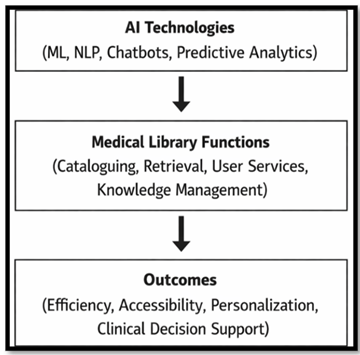
Figure 1 shows the conceptual framework on how artificial intelligence can be integrated in the medical libraries. It throws light on the interplay between AI technologies, library activities and healthcare outcomes and how smart systems increase access, processing and decision support of information.
|
Figure 1
|
|
Figure 1 Conceptual
Framework of AI Integration in Medical Libraries |
The framework demonstrates that AI acts as a central enabler connecting data processing, user interaction, and clinical decision-making. It also emphasizes the role of human oversight and ethical governance in ensuring reliable and responsible AI implementation.
LITERATURE REVIEW
AI Applications in Library and Information Science
The introduction of the artificial intelligence (AI) into the field of library and information science has moved the operations of the traditional library towards the intelligent and automated systems dramatically. Initial studies underline the possibility of AI to improve the process of cataloguing, classifying, and retrieving information with the help of machine learning and expert systems Asemi et al. (2021). Those technologies allow libraries to work with great amounts of data more effectively and enhance the accuracy and consistency of metadata creation.
Recent research also indicates that AI application in libraries goes beyond the technical services to incorporate user-focused services like reference services, information literacy, and personalized recommendations Ayinde et al. (2026), Cox (2023). For example, chatbots powered by AI have been widely implemented to offer customers real-time support, allowing libraries to offer 24/7 and take into account numerous user requests at the same time Panda and Chakravarty (2022). On the same note, the machine learning-powered recommendation system examines user behavior in order to recommend relevant resources, which increases user engagement and satisfaction Jha (2023), Xu et al. (2026).
In addition, the introduction of generative AI and large language models has brought about additional possibilities of synthesizing knowledge and automated content generation. They assist the work of the librarian in knowledge management by supporting tasks like summarizing research articles, helping in literature reviews, and detecting gaps in research Xu et al. (2026), Wang et al., 2026). Nevertheless, regardless of those innovations, the literature shows that most AI opportunities in libraries are still in their experimental or pilot phases, with little large-scale use and testing Ayinde et al. (2026).
Healthcare Information Systems AI.
As per the tendencies in the sphere of library science, AI has significantly influenced the healthcare information systems, where it is easier to use advanced data analysis and clinical decision support, and even to automate the administration process. It is likely that artificial intelligence will gain significance in the quantity of clinical data processing, pattern identification, and prediction generation to improve the quality of the diagnostic process and care plan Secinaro et al. (2021), Bracken et al. (2025).
To be more precise, the natural language processing (NLP) has become among the most significant applications in extracting meaningful information in unstructured medical documents, e.g., clinical notes or research articles. The NLP-based systems enable automatic record keeping, enhance the search of information, and expand interactions between medical staff and patients Bracken et al. (2025). In addition, the AI-powered EHRs are now being introduced to provide real-time and context-sensitive suggestions to address the gap existing between the data availability and clinical applications Secinaro et al. (2021).
The Generative AI technologies also make the field of healthcare information systems broader as they allow automated summarization, knowledge extraction, and decision-making. But, the literature is continuously raising issues concerning the reliability, explainability, and ethical considerations of AI systems, especially when the situation is high stakes in medical care and accuracy is paramount Cox (2023), Xu et al. (2026). Possible solutions include algorithmic bias and lack of transparency as a problem that can lead to a lack of trust and restrict adoption, so the issue of the robustness of validation and governance frameworks is significant.
AI in Medical Libraries
The use of AI in medical libraries is the intersection of library science and health informatics making more efficient and user-friendly information provision possible. The use of AI technologies to improve information access and retrieval in medical libraries is progressively growing with semantic search engines, automated indexing systems, and intelligent chatbots Orubebe et al. (2024), Taj et al. (2024).
The AI-based tools can help medical libraries process and organize large volumes of biomedical data to enhance the speed and accuracy of literature search. Indicatively, automated indexing systems help in attaching subject headings and keywords thereby eliminating human labor and improving discoverability Lenert (2025). Likewise, AI-based chatbots can instantly respond to user requests and thus enable effective navigation through electronic materials and enhance the availability of services Panda and Chakravarty (2022), Jothi et al. (2025).
In addition, AI technologies support advanced functions such as predictive analytics and personalized information delivery. By analyzing user behavior and usage patterns, AI systems can recommend relevant resources and anticipate user needs, thereby enhancing the overall user experience Xu et al. (2026), Ayinde et al. (2026). However, studies indicate that the adoption of AI in medical libraries is still at an early stage, with significant variations across institutions and regions Orubebe et al. (2024).
|
Figure 2
|
|
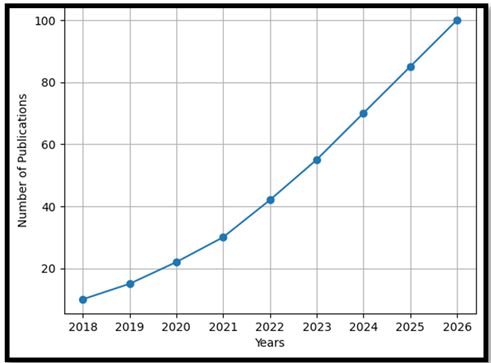
Figure 2 Growth of AI
Research in Medical Libraries (2018–2026) Source: Author’s Estimation Based
on Reviewed Literature |
Figure 2 presents the growth of AI-related research in medical libraries from 2018 to 2026. The upward trend indicates increasing scholarly attention and technological adoption in this field. This growth reflects the expanding role of AI in transforming information services and highlights the need for further empirical and interdisciplinary research.
Critical Analysis and Research Gaps
Although the research on AI in libraries and healthcare has expanded, there are a number of gaps that are important. One of the issues is first that there is a conspicuous unavailability of empirical, massive researches that assess the efficacy of AI implementations in actual medical library environment. A large portion of the available literature is conceptual in nature, case studies, or pilot projects, which restricts the generalizability of the results Ayinde et al. (2026), Xu et al. (2026).
Second, the lack of interdisciplinary collaboration of healthcare informatics and library science is indicated in the literature. Although the two areas study AI applications separately, the available literature is scarce to investigate the potential of AI in improving clinical decision-making and information services provided by libraries at the same time Secinaro et al. (2021), Orubebe et al. (2024). This fragmentation limits the creation of the holistic and integrated solutions.
Third, the problem of ethics and governance is not well-researched within the medical libraries. Even though some issues like data privacy, algorithm bias, and transparency are broadly described in the healthcare AI literature, their impact on the library services, in particular, regarding the user data and information credibility, needs further exploration Cox (2023), Echedom and Okuonghae (2021).
Fourth, medical libraries have no standardized frameworks to follow when adopting AI. The current literature does not have solid theoretical backgrounds, and the findings of research can hardly be implemented as the practical strategy Asemi et al. (2021), Ayinde et al. (2026). Also, the problem of digital inequality is not discussed adequately, with the majority of studies being concentrated on developed areas and neglecting the issues of less-typical settings, which lack resources Ajani et al. (2022).
Besides the gaps identified, the current literature has the tendency to focus on the possible positive outcomes of AI, and it reports more about the implementation failures and practical limitations less. Instead, most of the studies use a technology-focused approach, paying minimal attention to the behavior of the users, institutional level, and socio-economic aspects. Such an imbalance implies the need of more critical and context-specific studies, which analyze AI adoption across various healthcare and library settings.
Table 1
|
Table 1 Literature Summary |
|||
|
Author(s) |
Year |
Focus Area |
Key Findings |
|
Marshall et al. |
2013 |
Library services in healthcare |
Supports clinical decision-making |
|
Secinaro et al. |
2021 |
AI in healthcare |
Improves diagnosis and efficiency |
|
Asemi et al. |
2021 |
Intelligent libraries |
Enhances automation and services |
|
Echedom & Okuonghae |
2021 |
AI in academic libraries |
Opportunities with infrastructural challenges |
|
Ajani et al. |
2022 |
AI readiness |
Moderate awareness, need for training |
|
Panda & Chakravarty |
2022 |
AI chatbots |
Improves user interaction |
|
Jha |
2023 |
AI applications |
Efficiency gains with ethical concerns |
|
Cox |
2023 |
AI and library work |
Changes professional roles |
|
Orubebe et al. |
2024 |
Medical libraries |
Enhances access and services |
|
Taj et al. |
2024 |
AI in medical libraries |
Improves discovery and access |
|
Bracken et al. |
2025 |
AI in healthcare systems |
Reduces workload, improves accuracy |
|
Xu et al. |
2026 |
AI in information services |
Enables intelligent automation |
|
Ayinde et al. |
2026 |
AI adoption in libraries |
Expanding but limited evidence |
METHODOLOGY
Research Design
This paper will take a narrative review design as a research methodology to discuss the incorporation of artificial intelligence (AI) into medical libraries and the effect of AI on information services. Narrative review is especially fitting to conduct the synthesis of a wide and interdisciplinary literature as it enables the flexible and interpretative analysis of the present research in various fields, such as library and information science and healthcare informatics Asemi et al. (2021), Secinaro et al. (2021).
In contrast to purely protocol-based systematic reviews, the narrative one allows connecting the major themes and trends, as well as conceptual correlations in the literature. Particularly, it applies when considering AI because of the quick technological change and the introduction of new applications, a more integrative analytical system is needed Cox (2023), Xu et al. (2026). This design is aimed at giving a critical and full overview of the impact of AI technologies on the medical library services.
Data Sources and Search Strategy
In order to cover the relevant literature, several academic databases were searched such as Scopus, PubMed and Google scholar. These databases have been chosen as they provide a wide indexing of peer-reviewed journals in the healthcare industry, information science, and technology-related journals.
A combination of keywords and Boolean operators were used to carry out a structured search strategy. The major search words were:
· “artificial intelligence”
· “medical libraries”
· “AI in libraries”
· “healthcare information systems”
· “machine learning”
· “natural language processing”
· “digital libraries”
These keywords were combined using operators such as AND and OR to refine search results and enhance relevance. For example:
“artificial intelligence AND medical libraries”
“AI AND healthcare information systems AND libraries”
The search was primarily limited to studies published between 2018 and 2026 to capture recent developments and emerging trends, while selected earlier studies Marshall et al. (2013) were included to provide foundational context. Additionally, reference lists of key articles were manually examined to identify further relevant studies Orubebe et al. (2024), Ayinde et al. (2026).
Inclusion and Exclusion Criteria
To ensure the relevance and quality of the reviewed literature, specific inclusion and exclusion criteria were applied.
Inclusion Criteria:
· Peer-reviewed journal articles, conference papers, and review studies
· Studies focusing on AI applications in medical libraries, academic libraries, or healthcare information systems
· Publications written in English
· Studies published between 2018 and 2026
· Research addressing AI technologies such as machine learning, natural language processing, or intelligent systems
Exclusion Criteria:
· Studies not directly related to AI applications in libraries or healthcare contexts
· Non-scholarly sources such as editorials, blogs, and opinion pieces
· Publications lacking sufficient methodological or conceptual detail
· Duplicate records across databases
Data Extraction and Analysis
A structured data extraction process was employed to systematically collect relevant information from the selected studies. Key elements extracted included:
· Author(s) and year of publication
· Study objectives and scope
· Research methodology
· AI technologies applied
· Key findings and contributions
· Identified challenges and limitations
Thematic synthesis approach was used to analyze the extracted data, as it is a type of analysis involving the identification of recurring patterns and classifying them into significant concepts. The four dimensions considered in the analysis were:
1) AI applications in medical libraries
2) AI applications in healthcare information systems
3) Benefits and impacts of AI integration
4) Challenges, limitations, and research gaps
This approach enabled a comparative and interpretive analysis of the literature, highlighting areas of convergence and divergence across studies Xu et al. (2026), Ayinde et al. (2026). Additionally, attention was given to the evolution of AI applications over time, allowing for the identification of emerging trends and future research directions.
Reliability and Limitations of the Method
Although the narrative review method gives the researcher flexibility and in-depth analysis of the situation, it is subject to some limitations. The research is based on secondary information and available literature, which can be considered as the selection bias and restrict the empirical validation. Moreover, the published research has an impact on the results, and the majority of the studies are based on developed areas Ajani et al. (2022), Echedom and Okuonghae (2021).
To increase reliability, it was aimed at incorporating a variety of and quality sources, using the same selection criteria, and balancing the interpretation of findings. Regardless of such restrictions, the methodology is a sound theory that sheds light on the situation and the prospects of implementing AI in medical libraries.
SWIFT MEDICAL RELATED USES OF ARTIFICIAL INTELLIGENCE IN MEDICAL LIBRARIES.
The incorporation of AI in medical libraries has radically changed the conventional information services through automation, personalization, and intelligent processing of data. AI technologies are being introduced into library systems to allow improving information accessibility, simplifying processes, and ensuring evidence-based healthcare. In this section, the main AI applications are outlined and real applications are provided in the world to show the real impact of AI.
Virtual Assistants and AI-Powered Chatbots.
One of the most common tools used in medical libraries is artificial intelligence-based chatbots which are used to assist users in real-time when needed in addition to literature searches and navigation of the database. They use natural language processing (NLP) to process user input and provide contextually relevant responses to enhance the level of service accessibility and response time to a considerable extent Panda and Chakravarty (2022), Jha (2023).
Practically, a number of academic medical libraries have adopted the chatbot-based reference services to offer 24/7 services. These systems process common queries, support in resource search, and direct users in complicated databases. To illustrate, the use of chatbots in academic libraries has shown both user satisfaction and less workload on the side of librarians who can commit their time to other types of research support work Jothi et al. (2025).
Nevertheless, chatbots are not a reliable source of information, especially when it comes to medicine where false information can be disastrous. Consequently, it is necessary to provide human control and validation processes to make them accurate and reliable Cox (2023).
Information Retrieval and Natural Language Processing (NLP).
Natural language processing (NLP) is important in improving information retrieval in medical libraries since it allows semantic search and automation of text analysis. In contrast to the old system of searching with keywords, NLP can help the user to find the information by the contextual meaning, thus enhancing the search precision and efficiency Secinaro et al. (2021), Bracken et al. (2025).
One striking real-world application is the application of NLP in biomedical databases including PubMed, where AI-based tools assist in indexing and retrieving research articles automatically. Maximization of the literature search rate and accuracy with the use of NLP techniques have also allowed clinicians and researchers to access the needed information much faster Lenert (2025).
NLP is also commonly applied in the healthcare documentation systems to identify and process unstructured clinical data. Such features promote the knowledge organization and improved integration between medical libraries and medical health information systems Bracken et al. (2025).
Recommendation System and Personalization.
Machine learning algorithms used in recommendation systems can be applied to analyze user behavior and provide them with personalized content, including relevant research articles, clinical guidelines, and online resources. The systems assist in alleviating the overload of information by filtering large volumes of data and delivering a customized information stream to users Jha (2023), Xu et al. (2026).
Recommendation systems are especially useful in medical libraries where the information is needed by the professional medical personnel on time. These systems can be used to better the user engagement and efficiency in decision making by analyzing user search history and preferences Ayinde et al. (2026).
Nevertheless, the issue of data privacy and the bias of the algorithms should be considered and mentioned because individualized systems can unintentionally support the existing preferences and restrict access to a variety of sources of information Echedom and Okuonghae (2021).
Automated Metadata Generation and Indexing.
The use of AI in medical libraries is mainly through automated indexing, which allows the optimizing of the organization and classification of tons of biomedical information. The AI-powered systems apply machine learning and NLP to create metadata, assign subject headings, and categorize documents Asemi et al. (2021).
One of the most striking examples in the real world is the introduction of automated indexing in the National Library of Medicine where artificial intelligence helps in the allocation of Medical Subject Headings (MeSH). This has greatly shortened the time of indexing and preserved high accuracy levels thus enhancing the access to biomedical literature Lenert (2025).
Regardless of these strengths, automated systems might not have the same level of contextual awareness as human experts and so hybrid solutions, that is, combining artificial intelligence with human supervision, are necessary to perform optimally.
Predictive analytics and Decision support.
Predictive analytics will allow the medical libraries to use data to make strategic plans and decisions. When used to predict user needs, resource allocation, and detect new trends in research, AI systems can analyze the usage patterns, provide predictions, and forecast resource allocation Secinaro et al. (2021), Xu et al. (2026).
In the medical environment, AI-based recordkeeping and analytics assist in clinical decision-making by delivering pertinent data to the clinical system at the right moment. The systems increase the knowledge management systems and support evidence-based practice through the integration of library resources into clinical workflows Bracken et al. (2025).
Nonetheless, predictive models cannot be as effective as their effectiveness is determined by the quality of data, its transparency and the ethical considerations especially when handling sensitive healthcare data.
Table 2
|
Table 2 AI Applications in Medical Libraries (with Real-World Integration) |
||||
|
AI Application |
Function |
Real-World Example |
Key Benefits |
Challenges |
|
Chatbots |
User assistance, query handling |
Academic library chatbots |
24/7 support, reduced workload |
Accuracy, reliability |
|
NLP |
Semantic search, text analysis |
PubMed indexing systems |
Improved retrieval accuracy |
Complexity of medical language |
|
Recommendation Systems |
Personalized content delivery |
ML-based library systems |
Better user engagement |
Bias, privacy issues |
|
Automated Indexing |
Metadata generation |
NLM MeSH indexing |
Faster organization |
Lack of contextual understanding |
|
Predictive Analytics |
Trend analysis, decision support |
Healthcare AI systems |
Strategic planning |
Data dependency, transparency |
|
Figure 3
|
|
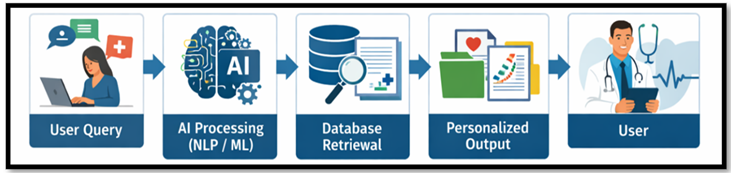
Figure 3 Workflow
Illustrating How Artificial Intelligence Processes User Queries and Delivers
Personalized Information Services in Medical Libraries |
Figure 3 illustrates the workflow of AI-driven information processing in medical libraries. It shows how user queries are processed through natural language processing, matched with relevant databases, and refined using machine learning algorithms to deliver personalized results. This workflow emphasizes the efficiency and intelligence of AI-based systems compared to traditional search mechanisms.
DISCUSSION
The integration of artificial intelligence (AI) in medical libraries represents not only a technological advancement but also a structural transformation in how knowledge is managed and delivered. While AI-driven systems significantly improve efficiency, accessibility, and personalization, their effectiveness is highly dependent on data quality, system design, and institutional capacity. This indicates that AI adoption is not universally beneficial but context-dependent, requiring careful evaluation of implementation environments.
Table 3
|
Table 3 Comparative Analysis of Traditional vs AI-Based Medical Libraries |
|||
|
Dimension |
Traditiona Medical Libraries |
AI-Based Medical Libraries |
Critical Analysis |
|
Information Retrieval |
Keyword-based search using controlled vocabularies
(e.g., MeSH) |
Semantic search using NLP and machine learning |
AI significantly improves retrieval accuracy and
reduces search complexity, but may introduce ambiguity if models are not
well-trained Secinaro
et al. (2021), Lenert (2025) |
|
User Interaction |
Manual assistance, limited service hours |
24/7 automated support via chatbots and virtual
assistants |
AI enhances accessibility and scalability;
however, lack of human judgment may affect response reliability Panda
and Chakravarty (2022), Cox
(2023) |
|
Personalization |
Standardized services for all users |
Personalized recommendations based on user data |
Improves user engagement but raises concerns about
privacy and filter bubbles Echedom and Okuonghae (2021), Xu et al. (2026) |
|
Operational Efficiency |
Labor-intensive cataloguing and indexing |
Automated processes using AI tools |
Automation reduces workload and increases
efficiency, but requires technical expertise and infrastructure Asemi
et al. (2021), Jha
(2023) |
|
Scalability |
Limited by human resources and physical infrastructure |
Highly scalable through digital and AI systems |
AI enables large-scale service delivery, especially in
digital environments Ayinde
et al. (2026) |
|
Accuracy & Reliability |
High (human-verified and peer-reviewed) |
Variable; depends on data quality and algorithms |
AI outputs require validation due to risks of
hallucination and bias Cox
(2023), Xu et al. (2026) |
|
Data Handling |
Structured and controlled datasets |
Large-scale, dynamic, and unstructured data processing |
AI enables advanced analytics but increases complexity
and data governance challenges Bracken
et al. (2025) |
|
Ethical Considerations |
Established professional and ethical standards |
Emerging concerns (bias, privacy, transparency) |
AI introduces new ethical risks requiring robust
governance frameworks Echedom
and Okuonghae (2021) |
|
Skill Requirements |
Library science expertise |
Hybrid skills (library + AI/technical knowledge) |
Necessitates reskilling and interdisciplinary training Cox
(2023), Ajani et al. (2022) |
Critical Interpretation
The comparative analysis shows that medical libraries that use AI provide significant efficiencies, accessibility, and personalization. NLP facilitated semantic search options enable users to access contextually pertinent information without necessarily being highly skilled at search and reduces cognitive load, as well as improves usability Secinaro et al. (2021). Likewise, chatbots that use AI can improve the service delivery process because it allows providing fast replies, which is one of the main limitations of conventional library systems Panda and Chakravarty (2022).
But there are serious challenges associated with these benefits. The question of the reliability of AI-generated information is among the most important because being inaccurate in medical situations can be disastrous. Contrary to the traditional systems that use human experience and peer-reviewed literature, the artificial intelligence systems can give false or biased data in case they are trained with incomplete or unrepresentative datasets Cox (2023), Xu et al. (2026).
Data privacy and ethical governance is another crucial matter. The literature cites that poor regulatory frameworks can increase the risks, especially in a healthcare setting where sensitive information is concerned Echedom and Okuonghae (2021), Bracken et al. (2025).
Moreover, the process of switching to AI-based systems requires the change of professional competencies. Librarians will have to acquire technical skills associated with AI tools, data analysis, and system management, which might be a challenge, both in terms of training and adaptation Ajani et al. (2022), Cox (2023). This change highlights how librarians are now turning into knowledge intermediaries and technology mediators due to the changing role of being information custodians.
One of the most important concerns which are raised as a result of this analysis is the risk of excessive dependence on the AI systems. Medical situations would be among the areas where a high degree of accuracy is needed, and overreliance on automated tools can result in accepting false or biased information. This brings out the importance of keeping human touch and radicalizing of librarian as an evaluator and moderator of information and not as a passive user of technology.
Synthesis with Existing Literature
The results of this paper are consistent with the existing literature that states that AI can be used to increase the efficiency of operations and access to information in both healthcare and library settings Secinaro et al. (2021), Asemi et al. (2021). Simultaneously, the findings are important because they add to the current body of knowledge by emphasizing the interdisciplinary features of AI integration in medical libraries, where the integration of healthcare informatics and library science forms new opportunities and challenges Orubebe et al. (2024), Ayinde et al. (2026).
Additionally, the previous research focuses more on the advantages of AI implementation, and this analysis offers a more objective view of this phenomenon by critically assessing related risks, such as the bias in algorithms, inability to guarantee transparency, and ethical issues. Such a comprehensive picture helps to learn more about the complexities of the implementation of AI-driven systems in medical libraries.
Implications of the Findings
The discussion suggests that the future of medical libraries lies in a hybrid model that combines AI capabilities with human expertise. Though AI can be used to automate routine operations and make them efficient, it cannot be confirmed that humans are not required to perform these functions accurately, ethically, and relevantly.
Additionally, institutions must invest in:
· Training and capacity building for library professionals
· Development of ethical and regulatory frameworks
· Infrastructure to support AI integration
· Such measures are crucial to maximizing the benefits of AI while mitigating associated risks.
IMPLICATIONS
Theoretical Implications
This study contributes to the growing body of knowledge at the intersection of library and information science and healthcare informatics by providing a synthesized understanding of how artificial intelligence (AI) transforms medical library services. It extends existing literature by emphasizing the interdisciplinary nature of AI integration, where technological innovation intersects with information management and clinical decision support Secinaro et al. (2021), Orubebe et al. (2024).
Furthermore, the study highlights the need for conceptual frameworks that integrate technological, organizational, and user-centered perspectives. Existing research often lacks strong theoretical grounding Asemi et al. (2021), Ayinde et al. (2026), and this paper addresses that gap by proposing a structured understanding of AI-driven transformation in medical libraries.
Practical Implications
From a practical perspective, the findings underscore the importance of strategic planning and capacity building for the successful adoption of AI in medical libraries. Institutions must invest in:
Training programs to enhance AI literacy among librarians
Integration of AI tools such as chatbots, NLP-based search systems, and recommendation engines
Development of robust data governance and privacy frameworks
Infrastructure to support scalable and secure AI systems
The study also highlights that AI can significantly improve operational efficiency, user engagement, and information accessibility, thereby enabling medical libraries to better support healthcare professionals and researchers Bracken et al. (2025), Jha (2023).
Policy Implications
The integration of AI in medical libraries raises important policy considerations related to data privacy, ethical governance, and standardization. Policymakers and institutional leaders must establish clear guidelines to ensure:
· Transparency and accountability in AI systems
· Protection of sensitive health-related data
· Mitigation of algorithmic bias
· Standardization of AI implementation practices
Such frameworks are essential to ensure that AI adoption is both responsible and sustainable Echedom and Okuonghae (2021), Cox (2023).
LIMITATIONS
Although it is an informative research, there are a number of limitations in this study.
To begin with, the study is founded on a narrative review of the existing literature that can create selection bias and undermine the applicability of the findings. The conclusions do not rely on the magnitude and quality of available studies as it is in the case of empirical studies.
Second, the research is mainly based on the secondary data, with little reference to the real-life quantitative evidence. This limits the possibility of quantifying the real effects of implementation of AI in the medical libraries.
Third, the literature reviewed is predominantly derived from developed regions, potentially overlooking challenges specific to developing countries, such as infrastructural constraints and limited technical expertise Ajani et al. (2022).
Lastly, the pace at which AI technologies are evolving is high, and therefore, some of their findings can become obsolete during the period when other tools and applications will come into existence.
RECOMMENDATIONS
Based on the findings, the following recommendations are proposed:
For Medical Libraries
· Adopt a phased approach to AI implementation, starting with pilot projects
· Integrate AI tools such as chatbots and NLP-based retrieval systems
· Ensure continuous evaluation and validation of AI outputs
For Library Professionals
· Develop AI literacy and technical skills through training and professional development
· Embrace interdisciplinary collaboration with IT and healthcare professionals
· Maintain a balance between automation and human expertise
For Researchers
· Conduct empirical studies to evaluate the effectiveness of AI applications in medical libraries
· Develop theoretical models and frameworks for AI adoption
· Explore the impact of AI in resource-constrained environments
For Policymakers
· Establish ethical guidelines and regulatory frameworks for AI use
· Promote investment in digital infrastructure and innovation
· Encourage standardization and best practices in AI implementation
CONCLUSION
The use of artificial intelligence (AI) in medical libraries is an upheaval in the delivery of information services in healthcare facilities. It is demonstrated in this paper that AI technologies, such as natural language processing, machine learning, and predictive analytics, could be employed to enhance information retrieval, performance in the operations, and interaction with the user on a significant level.
AI-powered systems allow medical libraries to transform into knowledge centers that are user-friendly, intelligent, and evidence-based to promote evidence-based clinical decision-making and research. Chatbots, automated indexing, and recommendation systems are only one of the applications that have made accessibility more accessible, and workflows more simplified, indicating possibilities of AI to transform library services.
Nevertheless, the paper also shows that there are some crucial challenges such as data privacy issues, bias in algorithms, the absence of technical skills, and infrastructural constraints. The mentioned concerns support the idea that the balanced and responsible attitude toward the adoption of AI should be implemented, which means combining technological innovation with human control and ethical regulation.
The results indicate that medical libraries will have a future based on a hybrid model, in which AI will not displace, but will support human knowledge. Institutions can ensure sustainability, transparency, and reliability by investing in training, infrastructure, and policy development to harness the full potential of AI.
To sum up, AI has great potential in changing the medical libraries but the successful deployment of the technology will require strategic planning, collaboration, and evaluation across disciplines. With the shift to more data-driven healthcare systems, medical libraries will become more important in the digital era in terms of bridging the information/clinical practice divide.
The next phase of research must be conducted on the
context-specific models that are empirically verified to be effective and fair
in the wide variety of medical settings when using AI in medical libraries.
ACKNOWLEDGMENTS
None.
REFERENCES
Ajani, Y. A., Tella, A., Salawu, K. Y., and Abdullahi, F. (2022). Perspectives of Librarians on Awareness and Readiness of Academic Libraries to Integrate Artificial Intelligence for Library Operations and Services in Nigeria. Internet Reference Services Quarterly, 26(4), 213–230. https://doi.org/10.1080/10875301.2022.2086196
Asemi, A., Ko, A., and Nowkarizi, M. (2021). Intelligent Libraries: A Review on Expert Systems, Artificial Intelligence, and Robot. Library Hi Tech, 39(2), 412–434. https://doi.org/10.1108/LHT-02-2020-0038
Ayinde, L., Ebiefung, R., and Oladokun, B. D. (2026). Adoption of Artificial Intelligence in Academic Libraries: A Systematic Review of Current Practices, Challenges, and Research Opportunities. The Journal of Academic Librarianship, 52(1), 103185. https://doi.org/10.1016/j.acalib.2025.103185
Bracken, A., Reilly, C., Feeley, A., et al. (2025). Artificial Intelligence (AI)-Powered Documentation Systems in Healthcare: A Systematic Review. Journal of Medical Systems, 49, 28. https://doi.org/10.1007/s10916-025-02157-4
Cox, A. (2023). How Artificial Intelligence Might Change Academic Library Work: Applying the Competencies Literature and the Theory of the Professions. Journal of the Association for Information Science and Technology, 74(3), 367–380. https://doi.org/10.1002/asi.24635
Echedom, A. U., and Okuonghae, O. (2021). Transforming Academic Library Operations in Africa With Artificial Intelligence: Opportunities and Challenges: A Review Paper. New Review of Academic Librarianship, 27(2), 243–255. https://doi.org/10.1080/13614533.2021.1906715
Georgieva, E., and Georgiev, T. (2025, July). How Artificial Intelligence Can Transform Services in Research Libraries. In International Conference on Intelligent and Fuzzy Systems (703–716). Springer Nature Switzerland. https://doi.org/10.1007/978-3-031-98565-2_76
Jha, S. K. (2023). Application of Artificial Intelligence in Libraries and Information Centers Services: Prospects and Challenges. Library Hi Tech News, 40(7), 1–5. https://doi.org/10.1108/LHTN-06-2023-0102
Jothi, T., Dominic, J., and Jaganbabu, J. (2025, January). Enhancing Medical Libraries: AI-Driven Tools and Techniques for Digital Transformation and Sustainable Innovation. In Proceedings of the 2025 International Conference on Multi-Agent Systems for Collaborative Intelligence (ICMSCI) (1182–1186). IEEE. https://doi.org/10.1109/ICMSCI62561.2025.10893904
Lenert, L. A. (2025). How the National Library of Medicine Should Evolve in an Era of Artificial Intelligence. Journal of the American Medical Informatics Association, 32(5), 968–970. https://doi.org/10.1093/jamia/ocaf041
Marshall, J. G., Sollenberger, J., Easterby-Gannett, S., Morgan, L. K., Klem, M. L., Cavanaugh, S. K., Oliver, K. B., Thompson, C. A., Romanosky, N., and Hunter, S. (2013). The Value of Library and Information Services in Patient Care: Results of a Multisite Study. Journal of the Medical Library Association, 101(1), 38–46. https://doi.org/10.3163/1536-5050.101.1.007
Orubebe, E. D., Ijaja, E. M., Ogwula, J. A., and Oladokun, B. D. (2024). Transforming Medical Libraries: Opportunities, Challenges, and Strategies for Integrating Artificial Intelligence. Asian Journal of Information Science and Technology, 14(2), 82–87. https://doi.org/10.70112/ajist-2024.14.2.4298
Panda, S., and Chakravarty, R. (2022). Adapting Intelligent Information Services in Libraries: A Case of Smart AI Chatbots. Library Hi Tech News, 39(1), 12–15. https://doi.org/10.1108/LHTN-11-2021-0081
Sagar, S. (2025). Low-Resource Fine-Tuning of LLMs for Domain-Specific Tasks. Universal Research Reports.
Secinaro, S., Calandra, D., Secinaro, A., et al. (2021). The Role of Artificial Intelligence in Healthcare: A Structured Literature Review. BMC Medical Informatics and Decision Making, 21, 125. https://doi.org/10.1186/s12911-021-01488-9
Sen, S. (2025). AI and Generative AI in Health and Medical Libraries: A Scoping Review of Present Use and Emerging Potential. Journal of EAHIL, 21(2). https://doi.org/10.32384/jeahil21675
Taj, A., Ahmed, M. G., Ali, K. S., and Senthilkumar, K. R. (2024). Revolutionizing Medical Libraries: The Vital Role of AI in Enhancing Discovery, Access, and Library Services for Healthcare Professionals. In Improving Library Systems With AI: Applications, Approaches, and Bibliometric Insights (24–38). IGI Global Scientific Publishing. https://doi.org/10.4018/979-8-3693-5593-0.ch002
Wang, J., Hodgson, R., and Shigematsu Locatelli, M. (2026). SMARTEN: A Human-AI Hybrid Framework for Assisted Medical Literature Analysis and Its Evaluation. BMC Medical Education. https://doi.org/10.1186/s12909-026-08837-0
Xu, Y. S., Yanti Idaya, A. M. K., and Kassim, M. S. S. (2026). How Do AI Technologies Augment Intelligent Information Services in Libraries? A Deep Learning-Based Topic Modeling and Temporal Analysis. Education for Information. https://doi.org/10.1177/01678329251374501
|
|
 This work is licensed under a: Creative Commons Attribution 4.0 International License
© JISSI 2026. All Rights Reserved.