|
|
|
|
Original Article
Application of Cloud Computing to Enhance the Performance of Effective E-Business Management
|
Mohammad
Imtiaz Hasan 1*, Most. Tahura Pervin 2 1 Student at Army Institute
of Business Administration Savar, Dhaka, Bangladesh 2 Professor, Department of
Humanities & Social Sciences, Dhaka University of Engineering &
Technology, Gazipur, Bangladesh |
|
|
|
ABSTRACT |
||
|
This research study investigates the advantages of employing Cloud Computing in the context of E-business Management in the market. We agree that Cloud Computing can improve the functionality of E-Business Management by providing a flexible and scalable infrastructure to meet the needs of enterprises of all sizes in there. The article explores the different applications of cloud computing in e-business, such as hosting e-commerce websites, maintaining customer data, and offering on-demand computer resources. The authors also cover the various problems and factors that firms should keep in mind while implementing cloud computing for their E-Business operations. The introduction of cloud computing has resulted in significant changes to how businesses operate and deliver services. Cloud computing has had an important effect on e-business. E-business is the use of electronic platforms to streamline business transactions and processes. The use of cloud computing in e-business has the possible to enhance operational while also providing firms with a flexible and scalable works that suits their requirements. Overall, the research contends that cloud computing has the possible to considerably improve the efficiency and effectiveness of E-Business, and that enterprises should carefully consider the benefits and drawbacks before taking to implement it also. Keywords: Cloud Computing, E-Business,
E-Commerce, Operate, Significantly, Flexible, Scalable |
||
INTRODUCTION
Cloud computing has evolved as a
game-changing technology for firm, offering unprecedented flexibility,
scalability, and cost savings now a days. Cloud computing, with its volume to
provide on-demand access to a pool of computer resources, has allowed enterprises
to quickly deploy new applications, services, and infrastructure without
incurring the costs and difficulties associated with traditional IT
infrastructure also in recent. This makes Cloud computing so perfect that they
need quick access power like Data storage, Computer power and software
applications. E-commerce makes the world so close that entrepreneurs are easily
doing their business in real time. After that, this e-commerce depends on that
type of IT infrastructure for contact with consumers and suppliers worldwide
easily. Using Cloud computing we get some advantages like expending
scalability, and workforce power. Cloud computing makes the availability to
identify the current market demand and make them and set up that according to
the scale of demand and supply. In this research we discussed the performance
of cloud computing. We'll look at the key advantages of cloud computing for
e-business, such as enhanced agility, lower costs, and better security also in
there. We will additionally go over the various cloud computing models and made
options accessible to e-businesses, as well as best practices for choosing the
correct cloud service provider and running cloud makes
also. subsequently this article intends to equip e-businesses with the insights
and assistance they need to effectively use cloud computing to perform their
business goals additionally Khan and Pervin (2024).
Cloud Computing has revolutionized
of the way businesses and individuals’ access and manage their data and
applications also now a days. It has shown as a powerful and flexible solution
to address the challenges of traditional IT works. In this say introduction, we
will explore the concept and benefits of cloud computing. Cloud computing also
says to the delivery of computing resources over the internet. Also, of that
depending on local servers or personal computers to see the store and process
data, cloud computing uses that network of remote servers owns on the internet
now. These servers, together known as the cloud, provide a wide range of
services, including storage, computing power, databases, software applications,
and more. One of the key advantages of cloud computing is its measure. Users
can easily measure or down their resources based on their needs, allowing for
efficient utilization and cost optimization in there also. With cloud services,
organizations no longer need to invest heavily in hardware and works, as they
can pay for what they use on a subscription or buy and get basis now. Cloud
computing also offers enhanced flexibility and accessibility also now a days.
Peoples can access their applications and data from any areas and any device with
an internet connection, also remote work, collaboration, and genuine updates
also. It can promote the productivity and increase the development, and that's
way employee use many platforms and smoothly works by that cloud computing.
Cloud computing's another importance opportunity is it is trustable and
protective. This provides information patterns and protect that in difference
way of places. It protects our information in any accidents or digesters. Cloud
computing easily adopts any new technologies. That's for helps us for in any
difficult situations and generate new ideas Khan et
al. (2024a).
It can help us in any difficult
situation and it also helps in taking loans as in very intellectual methods. It
is also included in taking loans, online marketing, customer services and in
selling also. And it also makes the world so fast in business and makes it
reliable for the businessmen. It is the main component in Online shopping and
E-commerce. Companies make stores online and so the products in online stores
so, customers easily Select the product by their choice. That's why businessmen
minimize their shop cost. So we can say cloud
computing savings is our extra cost, protect our money and customize our
selling. That's why cloud computing safe our business by fraud and other
things. And it can track customers information for any suspicious activities.
And connect with the customers easily. It collects customers data and reaches
them in social media according to their interest Khan and Sarkar (2024).
The statement of the
"Application of Cloud Computing to Enhance the Functionalities of
Effective E-Business Management" that also shows us that we can easily
minimize our all types of many threats which are included in traditional
business. And the primary element is scalability, which is very useful for
starting cloud computing. In the traditional way of business sometimes we
cannot do that easily and that's why start traffic problem in there. But using
of Cloud computing handle the situation so fluently. Data security is also a
concern. Businesses need the confidentiality, honesty, and data availability in
this modern age. Traditional works may not provide useful security measures to
protect against cyber threats, data breaches, and unauthorized access. This can
result in fame damage, financial losses, and legal senses for businesses
operating in the E-Business space. The problem statement, therefore, focuses on
exploring how the application of cloud computing can address these challenges
and help the working for effective E-Business. E-business is increase, but
sometimes people buy few, that makes it hard for businesses to works in well.
Cloud services help because they are cheap and give useful tools without need
much money at the start-up. They also keep data safe, so businesses do not have
to worry Khan et
al. (2024b).
This study looks at how cloud
computing can help make e-business work better. It will explore how using cloud
technology can improve different parts of an e-business and also look at the
benefits and challenges that come with it. The goal is to find smart and
practical ways for businesses to use cloud services effectively. One part of
the study will focus on using cloud systems to host e-business websites and
applications. It will look at how cloud services can offer flexible, fast, and
reliable hosting, which helps online businesses stay active and perform well.
The study will look at many types cloud services to see which one is good for
different types of businesses. It will can show how cloud can help in daily
business work. For example, cloud can help talk to customers, check products in
stock, and understand business data to make good opinions also. These stuffs
can improve business effectiveness and support better decision-making by
providing quick and easy access to important information Khan et
al. (2024a). Furthermore, the study will assess the impact of
cloud computing on the security and privacy of online business operations for
run the business. It will explore what security steps cloud providers take like
data encryption, access control, and regular backups to keep customer data and
business information safe. Lastly, the study will show the costs and possible
effective advantages of using cloud computing. It will look at how businesses
can save money by skip big stuff costs and first paying only for what they use,
which may lead to a better return on investment (ROI) also in there.
Businesses can scale their
operations up or down in response to demand thanks to cloud computing now
adays. For e-businesses that seasonal spikes or fluctuating traffic, this is
especially beneficial also. Businesses can easily make their computing power
and works by using cloud-based resources, guaranteeing cost-effectiveness and
peak performance now a day. Businesses no longer have to make significant
investments in servers and data centers or other
physical works when they use cloud computing. Also, using the subscriptions of
the cloud computing can be used. By using pay-as-you-go model we can minimize
our advance cost and utilize the assets and increase the efficiency and protect
the assets also. It can be protected from online server attack, for updating we
can easily protect the system. Nowadays it is used so much. We can set up the
backup for any unexpected accidents. And develop the trust worthy situations
for the business. As long as this is connected with the internet, Cloud
computing companies can easily provide access in any situation or place. For
e-businesses goals to reach a geographically measure clientele, this worldwide
accessibility is essential now. It enables businesses to provide a consistent
user experience across various locations and facilitates effective
collaboration among remote teams in together Pervin
and Khan (2025).
LITERATURE REVIEW
Since the start of cloud
computing, its massive leverage on many industries, including e-commerce, has
been highly discussed in academic and professional literature also Khan and Arif (2023), Khan et al. (2025), Khan et al. (2025) . nourishing a solid background on the impacts of
cloud computing is crucial for understanding its role in transforming
e-commerce also. Over the past decade, multiple studies have explored how cloud
computing reshapes business operations, enhances technological works, and
drives innovation across different sectors also. One main contribution to the
discussion comes from a study who examines the factors disrupting educational
information in rural China. The study identifies the lack of teaching resources,
deficient works, and low access to educational materials as key hedges to
progress in these regions. The study finish that cloud computing offers a
positive solution to these challenges by approving resource sharing, improving
availability, and demoting costs also. The research highlights several
potential benefits of cloud computing for educational information, focusing its
capacity to bridge educational gaps between urban and rural areas. However, it
is important to note that the study remains conceptual in nature, discussing
possible opportunities without providing actual documentation to support their
claims also. This lack of actual analysis limits the ability to generalize
their findings or assess the practical implications of adopting cloud computing
in rural education now a day Ping (2010).
Similarly, another study shows in
their papers the significant impacts of cloud computing on organizational
processes. Their research also shows a novel methodology for combining cloud
computing within firm operations, focusing on improving efficiency and
scalability in there. The authors illustrate the positive effects of cloud
computing through case studies of leading technology companies, including
Google, thereby enhancing the effectiveness of their arguments also. By showing
how major leverage cloud technologies to optimize performance, the paper
effectively proves the convert potential of cloud computing in real-world
settings. however, the study mostly identifies technical advances such as
enhanced computing power, data storage solutions, and network works. It
provides limited analysis of the broader business impacts, such as shifts in
business models, customer relations strategies, or competitive dynamics,
ethereally narrowing the scope of its contributions to the field of business
research Kashefi et al.
(2011).
In another study, shows the
challenges faced by mobile learning (m-learning) platforms in China. The author
identifies several barriers, including limited resources available to mobile
devices, lacking storage capacity for large educational tools, and the high
costs connected with hardware and software investments now a days. To take
these barriers, study proposes that cloud computing, with its reliable, modify
certified dynamic computing environments also, offers an effective solution.
The study forecasts that cloud computing will play a critical role in improving
the quality and accessibility of m-learning, promoting educational innovation
in mobile platforms also Shuai
(2011). Despite its insightful predictions, the paper
shares a similar limitation with the work of Ping (2010). it remains conceptual, lacking of empirical data
or case-based proof to prove its claims. The lack of actual testing leaves room
for further investigation to determine the practical outcomes of implementing
cloud computing in m-learning environments.
Shouliang
(2013), shifts the aim to see that the software
development industry, testing the impact of whole cloud computing on
traditional software projects on that basement. Through a comprehensive
analysis, Lai argues that conventional software development processes must
relocate to cloud-based environments to stay competitive and efficient. The
paper goes over simply identifying benefits by proposing comprehensive
relocation strategies, security measures, and specific tools to improve the
shift also. This approach provides useful information for advocates seeking to
adopt cloud computing in software development. The study shows lies in its dual
focus on both theoretical and practical dimensions in there, offering a
road-map for effective relocation while underscoring the potential gains in
flexibility, scalability, and security also. By showing concrete strategies,
Lai’s research donates to bridging the gap between theory and practice in cloud
computing applications.
Zhang
(2012), further develops the argumentation by
investigating the relationship between cloud computing and virtual assignment
performance management in the environment of fast economic development in
there. The study emphasizes the growing significance of virtually management
systems in modern firm and positions cloud computing as a critical enable of
this shift. By improving operational efficiency, data analytics qualifications,
and decision-making processes, cloud computing supports organizations in
piloting complex and dynamic business environments.
Multiple other scholars have also
interrogated the function of cloud computing in e-commerce and related sectors.
Explore the impact of cloud computing on the e-business trials of China’s
tourism industry in there for increase the business. Studies, offered how cloud
computing improves data management and customer service and operational
flexibility in the tourism sector also now a days. Their findings prove that
cloud-based solutions enable tourism businesses to better manage substantial
volumes of customer data, streamline booking processes, and offer
individualized services, thereby improving determination in a quickly
developing market also Jun (2010), Kashefi et al.
(2011), Zhang
(2012).
Security firms in cloud-based
e-commerce have also attracted literate attention. Study investigates the
security challenges connected with cloud computing in e-commerce and e-business
uses also. Their research identifies key susceptibility such as data offences,
improper access, and deference risks now a day. They propose security
frameworks and best practices to help these threats, highlighting the need for
healthy encrypt, access controls, and continuous covering in there also. Their
work contributes valuable insights for e-commerce businesses seeking to
safeguard customer data and conserve trust in cloud-based assignments. Finally,
the study provides a primitive analysis of the impact of cloud computing on
e-business in there. Their study investigates how cloud computing enables cost
discount, recallability, and improved service delivery in e-business missions
also. They argue that cloud computing allows businesses to borrow more flexible
and responsive models, enabling faster adjustment to market differences now a
days. Their research highlights the foundational role of cloud computing in
shaping the evolution of e-commerce by promoting innovation and improving
operative effectiveness also Wang (2013).
In the literature discovers that
cloud computing has been broadly respected for its convert impacts across many
sectors, including education, software development, and e-commerce in there.
While many studies emphasize its potential benefits, there is a distinguished
trend toward theoretical investigation rather than experimental evidence. This
gap shows chances for future research to provide data-driven insights into the
practical applications and definite outcomes of cloud computing in e-commerce.
proving objective evidence will be essential for fully understanding the extent
to which cloud computing can drive invention, efficiency, and competitive
opportunity in the digital marketplace also.
RESEARCH METHODOLOGY
RESEARCH DESIGN
Research design is an integral
part of research Khan (2019), Khan (2021), Khan and Sharma (2020). This current study followed a graphical research
design aimed at exploring the application of cloud computing to enhance the
operational of effective e-business among Bangladeshi business holders in
there. The research was conducted using a quantitative approach with the
support of a structured questionnaire Khan and Roy (2023), Khan et
al. (2022a). The focus of this study was to collect views and
understandings from selected business holders functioning in different shopping
malls in Dhaka, Bangladesh, including Shimanto Shambhar Shopping Mall, New Market, Jamuna Future Park,
Eastern Plaza and Bashundhara City for that research purpose and that’s way
make survey for that. The study highlighted primary data collection through
survey methods to assess the perception of cloud computing's effect on
e-business works in these selected areas Khan et al. (2019), Al Ahad and Khan (2020).
DATA
Two type
of data may use in research one is primary and another one is secondary data Hossain
et al. (2018), Khan et
al. (2022b). For this study, primary data was collected
directly from respondents through a structured questionnaire Al Ahad and Khan (2020), Roy et al. (2023). The survey included statements measured on a
five-point Likert scale, ranging from “Strongly Disagree” to “Strongly Agree,”
designed to capture the perceptions of business holders regarding the role of
cloud computing in their business operations also. A total of 135 valid
responses were collected from business holders in various shopping malls in
Dhaka city. For that collected data for necessary, effects, costs savings
benefits, scalability and disaster recovery support also has there. This data
reflects the real-time and experience for effective business strategy Khan et al. (2017), Khan and Roy (2023).
RESPONDENT SELECTION OF SAMPLE STRUCTURE, SAMPLE SIZE AND
SAMPLING STRATEGY
The main concern of the study was
surveying some popular market's business holders in Dhaka city. Making suitable
for the questionnaires we select 135 business holders for the sample
techniques. And this non-probability sample technique is convenient for the
researcher to collect data. The sample was considered satisfactory for
exploratory research purposes to provide initial insights into the perceptions
of cloud computing in the context of e-business in Bangladesh now a days.
During the survey sample size was made by the interviewees and suitable for
them Pervin
and Khan (2022), Khan et
al. (2022a).
DATA COLLECTION PROCEDURE
The collection of data was
operated by a closed-ended survey and made from Shimanto
Shambhar Shopping Mall, New Market, Jamuna Future
Park, Eastern Plaza, and Bashundhara City. And this can start by asking five
survey questions and this was relatable with their business and reflect the
business situation by cloud computing. The main concern of the researchers was
to get the real-life situation from their business. And the primary data was
based for that research. And it was also based on businessmen's willingness to
answer those questions Khan and Roy (2023).
RESEARCH PROCEDURE
This research is based on the
systematic methods by following. And before I start the survey
we are making questions, then collecting data, then data cleaning, data
analysis and results. And this is dependent on the literature and research that
was the main basement of that research also. And then we remove the unreliable
answer and make cleaning data. After that collecting the data of the response
then we are making the frequency and the percentile to understand the results Khan et al. (2017).
MEASUREMENT TECHNIQUES
Here we use descriptive
statistical methods for measuring their activists and reflection. The responses
were analyzed based on frequency counts and
percentage calculations to summarize the data collected through the Likert
scale methods. Each statement in the questionnaire was calculated by figuring
the percentage of respondents who selected each level of agreement (Strongly
Disagree to Strongly Agree) in here. The analysis provided insights into the
dominant perceptions and trends among the business holders regarding the
application of cloud computing in their e-business activities also in here. The
findings were presented in tables and figures to clearly display the response
distribution for each statement Al Ahad and Khan (2020).
DATA ANALYSIS, FINDINGS AND RESULTS
DATA ANALYSIS
|
Table 1 |
|||
|
Statements |
Scale |
Frequency |
Rate (%) |
|
Cloud
Computing need in your business to increase your business profit? |
Strongly Disagree |
6 |
4.44 |
|
Disagree |
12 |
8.89 |
|
|
Uncertain |
9 |
6.67 |
|
|
Agree |
57 |
42.22 |
|
|
Strongly Agree |
51 |
37.78 |
|
|
Strongly Disagree |
6 |
4.44 |
|
|
Disagree |
10 |
7.41 |
|
|
Uncertain |
8 |
5.93 |
|
|
Agree |
60 |
44.44 |
|
|
Strongly Agree |
51 |
37.78 |
|
|
Does cloud computing offer cost-saving
benefits for E-Business infrastructure and resources? |
Strongly Disagree |
5 |
3.7 |
|
Disagree |
13 |
9.63 |
|
|
Uncertain |
9 |
6.67 |
|
|
Agree |
56 |
41.48 |
|
|
Strongly Agree |
52 |
38.52 |
|
|
Strongly Disagree |
7 |
5.19 |
|
|
Disagree |
10 |
7.41 |
|
|
Uncertain |
10 |
7.41 |
|
|
Agree |
56 |
41.48 |
|
|
Strongly Agree |
52 |
38.52 |
|
|
Can cloud computing improve disaster recovery
and business continuity for e-business in your business for making profit? |
Strongly Disagree |
7 |
5.19 |
|
Disagree |
9 |
6.67 |
|
|
Uncertain |
8 |
5.93 |
|
|
Agree |
58 |
42.96 |
|
|
Strongly Agree |
53 |
39.26 |
|
|
Source: Author’s Calculation |
|||
The response rate to each question
will determine the current scenario and its implications in the context of
Bangladesh. Most of the respondents they also strongly agree on the impact of
‘Cloud Computing’ with its impact on their E-Business.
SUMMARY OF FINDINGS
From the analysis, it is evident
that in the context of Bangladesh, the majority of the 135 business holders
surveyed strongly recognize the essential role of cloud computing in their
business operations, particularly those based online. The results shows that
business holders are progressively aware of the benefits that cloud computing
offers for enhancing the effectiveness of e-business management. The data shows
that approximately 80% of the respondents either agreed or strongly agreed that
cloud computing plays a vital role in improving their business functionality,
including aspects such as cost savings, scalability, data security, and
operational efficiency. Interesting thing is, the findings reveal that an
average of 8 out of every 10 business holders confirmed the application of
cloud computing as a necessary tool to strengthen their e-business activities
nicely. This emphasizes a positive insight toward adjusting cloud-based
solutions to meet the progressing requirements of online business environments
in Bangladesh. Business proprietors reported that cloud computing allows them
to manipulate their resources more efficiently, access business applications
remotely, and ensure better apocalypse recovery planning also. The majority
expressed confidence in cloud computing’s potential to improve their
competitiveness and enable continuous business operations even during
challenging destinies but improve their selling. Overall, the study’s findings
suggest a growing awareness and goodwill among Bangladeshi business holders to
integrate cloud computing into their business models also in here. This trend
reflects an important shift regarding digital transformation in the country’s
business sector, particularly among businessmen and retailers operational in urban
marketable centers such as Shimanto
Shambhar Shopping Mall, New Market, Jamuna Future
Park, Eastern Plaza and Bashundhara City etc. for the survey to know their
using of cloud computing. The analysis emphasizes the importance role of cloud
computing in facilitating sustainable and efficient e-business practices,
paving the way for further advancements in the digital economy of Bangladesh in
recent.
CLOUD COMPUTING NEED FOR INCREASE E-BUSINESS
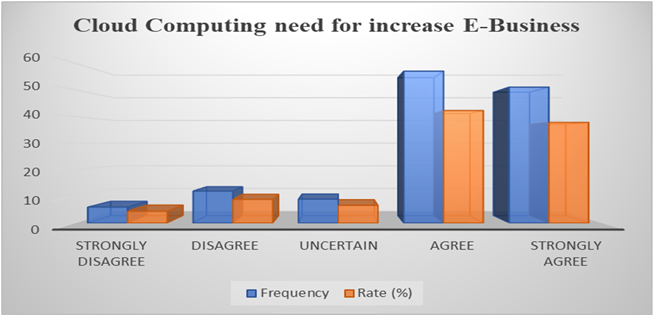
A survey of 135 business holders
in Bangladesh found that 37.78% strongly agreed and 42.22% agreed that cloud
computing is essential for enhancing e-business, while smaller proportions were
neutral (6.67%), disagreed (8.89%), or strongly disagreed (4.44%). This
highlights a strong positive perception toward adopting cloud computing for
business growth.
Figure 1
|
Figure 1 Cloud Computing
Need for Increase E-Business |
CLOUD COMPUTING EFFECT IN E-BUSINESS
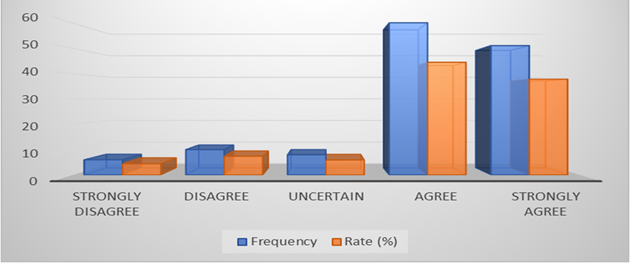
In Dhaka, a survey of 135 business
holders showed that 37.78% strongly agreed and 44.44% agreed that cloud
computing is vital for e-business, while 5.93% were undecided, and smaller
shares disagreed (7.41%) or strongly disagreed (4.44 %). This reflects strong
support for adopting cloud computing in business operations.
Figure 2
|
Figure 2 Cloud Computing Effect
in E-Business |
CLOUD COMPUTING OFFER COST-SAVING BENEFITS
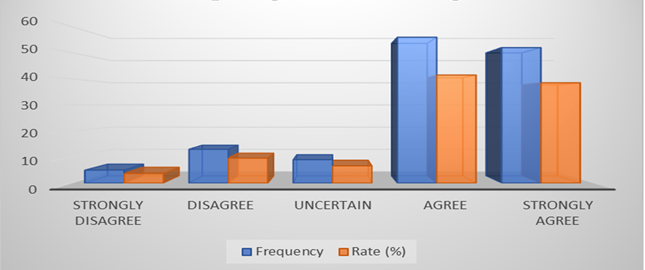
In Dhaka, a survey of 135 business
holders revealed that 38.52% strongly agreed and 41.48% agreed on the need for
cloud computing to enhance e-business, while 6.67 % were undecided, and smaller
percentages disagreed (9.63%) or strongly disagreed (3.7 %) in here. This
indicates broad recognition of cloud computing’s significance for business
growth.
Figure 3
|
Figure 3 Cloud Computing Offer Cost-Saving Benefits |
CLOUD COMPUTING PROVIDE ON-DEMAND CAPABILITY
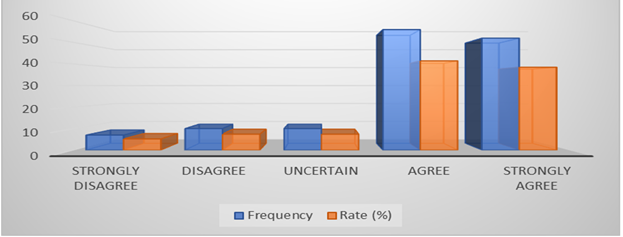
In Dhaka, a survey of 135 business
holders showed that 38.52% strongly agreed and 41.48% agreed on the necessity
of cloud computing for e-business, while 7.41% disagreed, 7.41% strongly
disagreed, and 5.19% were debatable. This shows a strong mention of cloud
computing’s role in business development in here.
Figure 4
|
Figure 4 Cloud Computing
Provide On-Demand Capability |
IMPROVE DISASTER RECOVERY AND BUSINESS CONTINUITY
In Dhaka, a survey of 135 business
holders revealed that 39.26% strongly agreed and 42.96% agreed that cloud
computing is crucial for e-business, while 5.93% were undecided, and smaller
proportions disagreed (6.67%) or strongly disagreed (5.19%) in here. This shows
a significant recognition of the importance of cloud computing in business
growth.
Figure 5
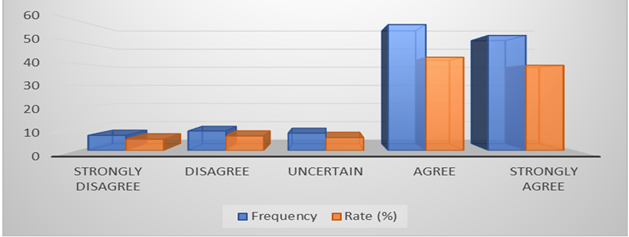
|
Figure 5 Improve Disaster
Recovery and Business Continuity |
DISCUSSION
The main concern of the study was
surveying some popular market's business holders in Dhaka city. Making suitable
for the questionnaires we select 135 business holders for the sample
techniques. The statement “Cloud computing need in your business for increased
your business profit?” received a high level of agreement, A survey of 135
business holders in Bangladesh found that 37.78% strongly agreed and 42.22%
agreed that cloud computing is essential for enhancing e-business, while
smaller proportions were neutral 6.67%, disagreed 8.89%, or strongly disagreed
4.44%. This identifies a strong positive insight toward adopting cloud
computing for business growth. Regarding
the question “Is Cloud Computing effect in your E-Business?”, 37.78% strongly
agreed and 44.44% agreed that cloud computing is vital for e-business, while
5.93% were undecided, and smaller shares disagreed 7.41% or strongly disagreed
4.44 %. This perception agrees with current trends in digital transformation
where cloud platforms are calculated vital for enhancing flexibility,
collaboration, and customer engagement in digital markets.
A critical dimension of the
analysis focused on cost-saving benefits of cloud computing. A substantial
38.52% strongly agreed and 41.48% agreed on the need for cloud computing to
enhance e-business, while 6.67 % were undecided, and smaller percentages disagreed
9.63% or strongly disagreed 3.7 % in here. This indicates broad recognition of
cloud computing’s meaning for business growth. When evaluating cloud
computing’s on-demand capability during peak periods, results showed 38.52%
strongly agreed and 41.48% agreed on the necessity of cloud computing for
e-business, while 7.41% disagreed, 7.41% strongly disagreed, and 5.19% were
debatable. This means trust in the flexibility and scalability of cloud
computing to handle fluctuating business demands, which is particularly crucial
for e-commerce platforms and digital service providers during promotional or
seasonal spikes.
Finally, the survey item exploring
whether cloud computing can improve disaster recovery and business continuity
for e-business was met with strong support 39.26% strongly agreed and 42.96%
agreed that cloud computing is crucial for e-business, while 5.93% were
undecided, and smaller proportions disagreed 6.67% or strongly disagreed 5.19%
in here. This highlights the belief that cloud systems enhance strength by
ensuring data backups, system redundancy, and rapid recovery machines, which
are essential in minimizing functioning downtimes and protecting profitability.
Collectively, these findings reveal a strong endorsement of cloud computing
across multiple dimensions of e-business. They also point to a producing
awareness among business stakeholders regarding the strategic and operational
advantages of adopting cloud-based solutions. As digital markets develop, the
ability of businesses to leverage cloud computing will likely be a key
determinant of competitiveness and sustainability.
CONCLUSION
Cloud computing plays a dynamic
role in helping e-businesses cultivate and stay competitive in today’s fast
changing market. By offering capability, it allows businesses to expand their
infrastructure and resources easily in response to changing demands without
heavy upfront investments in recent. This means companies can efficiently
manage high loads or sudden growth also. Additionally, we can say cloud
computing brings flexibility and easy to monitoring to e-business operations
also. It enables fast deployment and regular updates of applications also,
which helps businesses adjust quickly to market shifts or customer needs in
there. This fast adjusting allows them to launch new services or features
already of competitors now. Overall, cloud computing increase both flexibility
and sensitivity, that giving e-businesses the tools they need to innovate,
grow, and maintain a strong competitive position in a digital-first economy
also. It's a smart solution for modern business challenges.
RECOMMENDATIONS
Grounded on the
research conducted on the application of cloud computing to increase e-business
operational, several key recommendations can be made here. To begin with,
businesses should supervise a thorough analysis of their specific needs, goals,
and challenges before embracing any cloud-based solutions in here. This ensures
that the selected services align well with operational requirements also.
Choosing the right cloud service provider is also crucial that's why market
should assess multiple suppliers based on dependability, security standards,
compliancy certifications, pricing models, and customer-support also in there.
Since e-businesses often handle sensitive data, implementing robust security
measures such as encrypting, access control, and regular audits is essential to
protect information and maintain deference with data defense
laws also in here. Furthermore, e-business works and applications must be
designed with capability and elasticity in mind to accommodate tumor and respond swiftly to evolving market demands.
ACKNOWLEDGMENTS
None.
REFERENCES
Al Ahad, A., & Khan, M. R. (2020). Exploring the
Mediating Effect of Demographic Attributes on the Relationship Between Employee
Engagement and Organizational Citizenship Behavior. International Journal of
Management and Sustainability, 9(1), 11-23. https://doi.org/10.18488/journal.11.2020.91.11.23
Al Ahad, A., Khan, M. R., & Rahman, M. S.
(2020). HR Retention Strategies for Enhanced Job Satisfaction in a Highly
Competitive Job Market: A Study with Private Banking Sector in Bangladesh.
International Journal of Social Sciences Perspectives, 6(1), 53-58. https://doi.org/10.33094/7.2017.2020.61.53.58
Hossain,
S. K., Khan, M. R., & Haque, M. M. (2018). Corporate Voluntary
Disclosure Practices and its Association with Corporate Attributes: An
Empirical Investigation of Listed and Non-Listed Commercial Banks in
Bangladesh. International Journal of Managerial and Financial Accounting,
10(4), 331-351. https://doi.org/10.1504/IJMFA.2018.095972
Jun,
L. (2010, December). Influence of Cloud Computing on Educational
Informationization of China Rural Areas. In The 2nd International Conference on
Information Science and Engineering (pp. 281-283). IEEE. https://doi.org/10.1109/ICISE.2010.5691402
Kashefi,
F., Majdi, M., Darbandi, M., Purhosein, H., Alizadeh, K., & Atae, O. (2011,
October). Perusal About Influences of Cloud Computing on the
Processes of these days and Presenting new Ideas About its Security. In 2011
5th International Conference on Application of Information and Communication
Technologies (AICT) (pp. 1-4). IEEE. https://doi.org/10.1109/ICAICT.2011.6111007
Khan, M. R. (2019). Samson H.
Chowdhury: A true Entrepreneurial Leader for Square Group. EuroMed Journal of
Management, 3(2), 80-88. https://doi.org/10.1504/EMJM.2019.104323
Khan,
M. R. (2021). A Critical Analysis of Elon Musk's Leadership in Tesla
Motors. Journal of Global Entrepreneurship Research, 11(1), 213-222. https://doi.org/10.1007/s40497-021-00284-z
Khan, M. R., & Arif, M. Z. U. (2023). Systematic
Review of Disruptive Innovation (DI) Research in Agriculture and Future
Direction of Research. Telematics and Informatics Reports, 11, 100079. https://doi.org/10.1016/j.teler.2023.100079
Khan,
M. R., & Arif, M. Z. U. (2025). Operational Efficiency Through Disruptive
Innovation in Dairy Business: Evidence from an Emerging Economy. International
Journal of Productivity and Quality Management, 45(1), 66-93. https://doi.org/10.1504/IJPQM.2025.146575
Khan, M. R., & Pervin, M. T. (2024). Technology
Disruption and its Application in Organisational Management Theories: A Case
Study on Toyota Motor Corporation. International Journal of Services and
Operations Management, 49(2), 198-220. https://doi.org/10.1504/IJSOM.2024.141998
Khan,
M. R., & Roy, S. K. (2023). Do Primary HR Functions Model Work in Emerging
Economies? Sustainable Compact Perspective for Bangladeshi RMG Industry. Review
of International Business and Strategy, 33(2), 328-341. https://doi.org/10.1108/RIBS-04-2021-0065
Khan,
M. R., & Sarkar, U. (2024). Business Leadership in the Digital age: IKEA's
Story in the Retail And Consumer Sector. Green Technologies and Sustainability,
2(2), 100081. https://doi.org/10.1016/j.grets.2024.100081
Khan, M. R., &
Sharma, K. (2020). Purchase Preferences and Buying Influences on Religious
Occasions. FIIB Business Review, 9(3), 216-227. https://doi.org/10.1177/2319714520942624
Khan, M. R.,
Arafin, M., & Hossain, S. K. (2017). The Practice of Basic HR
Functions in Garments Industry in Bangladesh: Focus Group Finding. Journal of
Management and Sustainability, 7(3), 120-132. https://doi.org/10.5539/jms.v7n3p120
Khan, M. R., Arif,
M. Z. U., & Ali, M. (2024b). Consumers' Perceptions Towards Cell Phone Brand
Preference: The Case of Bangladesh. International Journal of Management
Studies, 31(1), 137-170. https://doi.org/10.32890/ijms2024.31.1.6
Khan, M. R., Arif, M. Z. U., & Rammal, H. G.
(2025). Disruptive Production Process Innovation for Sustainable Business:
Evidence from an Emerging Economy. Business Process Management Journal, 31(4),
1349-1370. https://doi.org/10.1108/BPMJ-11-2023-0872
Khan,
M. R., Pervin, M. T., Arif, M. Z. U., & Hossain, S. K. (2024a). The Impact of
Technology Service Quality on Bangladeshi Banking Consumers' Satisfaction
During the Pandemic Situation: Green Development and Innovation Perspective in
Banking Service. Innovation and Green Development, 3(2), 100120. https://doi.org/10.1016/j.igd.2023.100120
Khan,
M. R., Rana, S., & Hosen, M. I. (2022). Impact of
Trustworthiness on the Usage of M-Banking Apps: A Study on Bangladeshi
Consumers. Business Perspectives and Research, 10(2), 234-250. https://doi.org/10.1177/22785337211001969
Khan, M. R., Roy, M. K., & Chowdhury, S. H. (2022a). The impact of
Work-Family Balance on Manufacturing Employees' Mental Health During Pandemic.
Organizational Psychology, 12(4), 29-40. https://doi.org/10.17323/2312-5942-2022-12-4-29-40
Kan, M. R., Roy, S. K., & Hossain, S. M. (2019). Factors
Affecting Garments Employees' Perception on Job Performance: Evidence from
Bangladesh. International Journal of Management and Sustainability, 8(1),
32-47. https://doi.org/10.18488/journal.11.2019.81.32.47
Khan,
M. R., Roy, S. K., & Pervin, M. T. (2022b). Retail-Based Women
Entrepreneurship Entry Model Through Small Business Orientation (SBO). Journal
of Women's Entrepreneurship and Education (JWEE), (1-2), 117-136. https://doi.org/10.28934/jwee22.12.pp117-136
Khan, R., & Roy, S. K. (2023). Moderating Effect
of M-Banking Apps Users' Demographic Variables on the Relationship Between the
Ease of Use and Brand Trust. European Journal of Business Science and
Technology, 9(2), 249-265. https://doi.org/10.11118/ejobsat.2023.015
Pervin,
M. T., & Khan, M. R. (2025). The Impact of Social Media Marketing on Consumers'
Buying Decisions in the Restaurant Industry: Mediating Role of Trustworthiness.
Jindal Management Journal, 14(1), 28-48. https://doi.org/10.1177/22786821241235741
Pervin, T., & Khan,
R. (2022). The Impact of Organisational Career Management and Supporting
System on Generation Y Employees'
Career Satisfaction and Intention to Stay in the Textile Industry.
SCMS Journal of Indian Management, 19(3), 34-50.
Ping, Y. (2010,
July). A Study on Innovations of E-Business Models for Chinese Tourism
Industry. In 2010 International Forum on Information Technology and
Applications (Vol. 3, pp. 413-416). IEEE. https://doi.org/10.1109/IFITA.2010.268
Roy, S. K., Khan,
M. R., & Shanto, N. I. (2023). Bankers' Job Stress, Job Performance, and Job
Commitment Trajectories During the COVID-19 Pandemic. Journal of
Entrepreneurship, Management and Innovation, 19(3), 203-228. https://doi.org/10.7341/20231936
Shouliang, L.
(2013, January). The Influences of Cloud Computing to the Traditional
Software Project and our Corresponding Strategies. In 2013 Third International
Conference on Intelligent System Design and Engineering Applications (pp.
1461-1464). IEEE. https://doi.org/10.1109/ISDEA.2012.349
Shuai,
Q. (2011, December). What Will Cloud Computing Provide for Chinese M-Learning?
In Proceeding of the International Conference on e-Education, Entertainment and
e-Management (pp. 171-174). IEEE. https://doi.org/10.1109/ICeEEM.2011.6137777
Wang, X. F. (2013). Cloud Computing Security
of E-Commerce Environment. Applied Mechanics and Materials, 347, 3377-3380. https://doi.org/10.4028/www.scientific.net/AMM.347-350.3377
Zhang, H. (2012, July). Research on the Influence of Cloud Computing on the Virtual Operation Performance Management. In 2012 7th International Conference on Computer Science & Education (ICCSE) (pp. 235-238). IEEE. https://doi.org/10.1109/ICCSE.2012.6295065
|
|
 This work is licensed under a: Creative Commons Attribution 4.0 International License
© JISSI 2025. All Rights Reserved.


